Sunday, June 17, 2007

Prof. Philip Jenkins on Europe’s Christian Comeback

The West is awash with fear of the Islamization of Europe. The rise of Islam, many warn, could transform the continent into “Eurabia,” a term popularized by Harvard historian Niall Ferguson and other pundits. “A youthful Muslim society to the south and east of the Mediterranean is poised to colonize—the term is not too strong—a senescent Europe,” Ferguson has predicted. Such grim prophecies may sell books, but they ignore reality. For all we hear about Islam, Europe remains a stronger Christian fortress than people realize. What’s more, it is showing little sign of giving ground to Islam or any other faith for that matter.

...

In fact, the rapid decline in the continent’s church attendance over the past 40 years may have done Europe a favor. It has freed churches of trying to operate as national entities that attempt to serve all members of society. Today, no church stands a realistic chance of incorporating everyone. Smaller, more focused bodies, however, can be more passionate, enthusiastic, and rigorously committed to personal holiness. To use a scientific analogy, when a star collapses, it becomes a white dwarf—smaller in size than it once was, but burning much more intensely. Across Europe, white-dwarf faith communities are growing within the remnants of the old mass church.

Perhaps nowhere is this more true than within European Catholicism, where new religious currents have become a potent force. Examples include movements such as the Focolare, the Emmanuel Community, and the Neocatechumenate Way, all of which are committed to a re-evangelization of Europe. These movements use charismatic styles of worship and devotion that would seem more at home in an American Pentecostal church, but at the same time they are thoroughly Catholic. Though most of these movements originated in Spain and Italy, they have subsequently spread throughout Europe and across the Catholic world. Their influence over the younger clergy and lay leaders who will shape the church in the next generation is surprisingly strong.

...

Alongside these older Christian communities are hugely energetic immigrant congregations. On a typical Sunday, half of all churchgoers in London are African or Afro-Caribbean. Of Britain's 10 largest megachurches, four are pastored by Africans. Paris has 250 ethnic Protestant churches most of them black African. Similar trends are found in Germany. Booming Christian churches in Africa and Asia now focus much of their evangelical attention on Europe. Nigerian and Congolese ministers have been especially successful, but none more so than the Ukraine-based ministry of Nigerian evangelist Sunday Adelaja. He has opened more than 300 churches in 30 countries in the last 12 years and now claims 30,000 (mainly white) followers.

Ironically, after centuries of rebelling against religious authority, the coming of Islam is also reviving political issues most thought extinct in Europe, including debates about the limits of freedom of speech, freedom of religion, and the right to proselytize. And in all these areas, controversies that originate in a Muslim context inexorably expand or limit the rights of Christians, too. If Muslim preachers who denounce gays must be silenced, then so must charismatic Christians. At the same time, any laws that limit blasphemous assaults on the image of Mohammed must take account of the sensibilities of those who venerate Jesus.

The result has been a rediscovery of the continent’s Christian roots, even among those who have long disregarded it, and a renewed sense of European cultural Christianity. Jürgen Habermas, a veteran leftist German philosopher stunned his admirers not long ago by proclaiming, “Christianity, and nothing else, is the ultimate foundation of liberty, conscience, human rights, and democracy, the benchmarks of Western civilization. To this day, we have no other options [than Christianity]. We continue to nourish ourselves from this source. Everything else is postmodern chatter.” Europe may be confronting the dilemmas of a truly multifaith society, but with Christianity poised for a comeback, it is hardly on the verge of becoming an Islamic colony.

http://www.foreignpolicy.com/story/cms.php?story_id=3881

The synthesis of faith and culture

The Pope said that "the history of the Church is inseparably linked to the history of culture and art."

The Holy Father made reference to various works, "such as the Summa Theologiae of St. Thomas Aquinas, the 'Divine Comedy,' the Cathedral of Chartres, the Sistine Chapel and the cantatas of Johannes Sebastian Bach."


"These constitute incomparable syntheses of the Christian life and of human expression," said the Pontiff.


Benedict XVI clarified: "If, indeed, these are, so to speak, pinnacles of the synthesis between faith and culture, their encounter is realized daily in the life and the work of the baptized, in that hidden work of art which is the love story of each individual with the living God and with one's neighbor, in the joy and toil of following Christ in everyday life.


"In the cultural arena, Christianity has to offer everyone its powerful capacity for renewing and lifting up, that is, the love of God that becomes human love."


http://www.zenit.org/article-19888?l=english

Wednesday, May 30, 2007

A commom 'Christian soul' in the world

The Pope reflected on Tertullian's thought at today's general audience in St. Peter's Square, resuming his series of catecheses on the Apostolic Fathers.

"His work bore decisive fruits, and it would be unforgivable to undervalue them," the Holy Father said. "His influence is developed on many levels: linguistically and in the recovery of the classic culture, and the singling out of a common 'Christian soul' in the world and the formulation of new proposals for living together.


http://www.zenit.org/english/visualizza.phtml?sid=108630

Tuesday, October 24, 2006


Photograph of actor Sir Alec Guinness standing with historian Christopher Dawson at Boston College-sponsored birthday party for Dawson on November 8, 1959. Posted by Picasa

Wednesday, October 26, 2005

Monday, October 17, 2005

An Interview with René Girard


An interesting interview with René Girard
on Pope Benedict, the dictatorship of relativism, the uniqueness of Christianity, postmodernism, globalization, Islam, values beyond materialism or, as Pope put it, "egoism and desire," and the Pope versus Madonna for the soul of western civilization!

Wednesday, October 12, 2005

Healing the Rift Between Faith and Culture (Part 2)

ROME, OCT. 12, 2005 (Zenit.org).- An editor of a Catholic journal on culture and anthropology says it is possible to recover the spiritual unity of the culture without giving up scientific progress.

Jaime Antúnez Aldunate, editor of the Chile-based review Humanitas, spoke with ZENIT about promoting dialogue between faith and culture. The occasion was the 10th anniversary of Humanitas.

Part 1 of this interview appeared Tuesday.

Q: From the perspective of culture and considering a context such as that of the present -- unified, organized and controlled by knowledge and scientific techniques -- what challenge do you see for religion, and particularly for the great universal religions?

Antúnez: It was described and analyzed by [Christopher] Dawson himself, in whose judgment -- and he already said this in the '40s -- they all survive and continue to influence human life, but all of them have lost their organic relationship with society, which was expressed in the traditional synthesis of religion and culture, both in the East as well as the West.

Therefore, the British philosopher concludes, what we have before our eyes is the most complete, intense and widespread secularization that the world has ever known and, in this connection, what is prevailing as culture in no way is culture in the traditional sense; that is, it is not an order that includes all the aspects of human life in a living spiritual community.

Q: Is this judgment also valid for the Islamic world?

Antúnez: It is, because by the force of events it suffers the same effects. Meanwhile, in all this, one must take very much into account that the vision of contemporary Islam that we are given by the media is that of an ideology much more than that of a religion. An ideology in which the factors of violence that nestle in it are also much more Western than indigenous.

Q: Given the context of technocratic unification that predominates at present, is it possible to recover the spiritual unity of the culture without giving up scientific progress?

Antúnez: It should be, as that scientific-technical progress which we see prevail in the world today, established its foundations and had its beginning and first impulse from a profoundly spiritual and religious culture, such as that of the Christian West.

But what would have to be done is to recover that unity, not to replace it. And I say this, because precisely what is characteristic of the present technocratic era is the absence of such unification. Contrary to it, today we live in a world in which fragmentation predominates, without a counterbalance.

We live, in fact, in an acentric society, as Luhmann has called it, indicating with this the lack of a representation of all in the all, as existed in societies in which religion assumed such representation naturally. Thus, for example, and very particularly, [there is] in the Christian society and culture, whose keystone is Christ, the revelation of the mystery of the Father and his love, the perfect man who has given back to Adam's posterity the divine likeness, and which fully manifests man to himself showing him the sublimity of his vocation, as the Council teaches and the encyclical "Redemptor Hominis" recalls.

In view of all the preceding -- with the nuances that correspond to each age -- it doesn't seem bold to affirm that, just as a society that loses its religion becomes, sooner or later, a society that loses its culture, it also seems true to affirm that it is the religious impulse par excellence which gives a society and culture its unifying cohesive force.

Q: What should be done to effect this recovery?

Antúnez: The "technical solutions," so much a part of our contemporary mentality, would have to be discarded. More than that, it is a question of awareness, of becoming aware in order to proceed in awareness.

Awareness, in the first place, of the depth and gravity of that heart-rending cry of Paul VI when he warned how the great tragedy of our time is the rupture or divorce between faith and culture.

Awareness of what John Paul II said that day in May 1982 when he signed the creation of the Pontifical Council for Culture: A faith that does not become culture is a faith that is not accepted in fullness, not thought out in its totality, not lived with fidelity.

Awareness, then, of the mandate given 15 years ago to Catholic universities by the apostolic constitution "Ex Corde Ecclesiae" and the immense hope placed in it.

Awareness, finally, of what Benedict XVI said in Subiaco, at the conclusion of the last conference he delivered as a cardinal of the holy Church, evoking the figure of St. Benedict:

"We need men who have their gaze directed to God, to understand true humanity. We need men whose intellects are enlightened by the light of God, and whose hearts God opens, so that their intellects can speak to the intellects of others, and so that their hearts are able to open up to the hearts of others. Only through men who have been touched by God, can God come near to men."

Healing the Rift Between Faith and Culture (Part 1)

ROME, OCT. 11, 2005 (Zenit.org).- For 10 years the Chile-based Catholic review Humanitas has been promoting dialogue between faith and culture.

For the 10th anniversary of the publication, ZENIT interviewed its editor, Jaime Antúnez Aldunate.

Antúnez holds a doctorate in philosophy. He is a member of the Academy of Social, Political and Moral Sciences of the Institute of Chile.

Part 2 of this interview appears Wednesday.

Q: From your experience over these years, do you think it is possible to overcome the "divorce" between faith and culture?

Antúnez: With the grace of God, we cannot deny that this and much more is perfectly possible.

By overcoming that "divorce," it might be possible to advance decidedly toward a situation -- as has been witnessed so many times in so many places over 2,000 years of Christianity -- in which faith in Christ becomes the keystone of culture.

The profound relationship between faith and culture is something, moreover, which is appreciated in the genesis and development of all the greatest and oldest civilizations.

Q: But in the intensely secularist atmosphere that prevails in our time, where in many countries characterized by a Christian past, including the Ibero-American, political-cultural actions are being taken of an aggressive secularist bias, does this not seem to be far removed from reality?

Antúnez: In the same measure in which the prevailing atmosphere is difficult and adverse, there are people and nuclei of Christians that are becoming aware of the problem and acting as a consequence.

The existence and development of a culture is something that is not limited and that is far beyond the spectacle, the event or the theater world, which greatly catch the attention of the media in our time. It is an error to confuse this plane with what philosophy properly calls culture.

Sufficiently removed from all this, the real traces of what is culture are found in an horizon that transcends us and that in that same sense invites us to be genuinely free.

It was said magnificently by John Paul II in his address to the U.N. General Assembly in 1995: Every culture is an effort to reflect on the mystery of the world and, in particular, of man: It is a way of manifesting the transcendent dimension of human life. The heart of every culture is constituted by its approach to the greatest of all mysteries: the mystery of God.

Q: In what way do you say that culture invites us to be free? Is there not, perhaps, in the aforementioned an ideological conditioning?

Antúnez: Very much the contrary. An ideology, in the modern sense of the word, is something different from faith, even if it tends to corner the same sociological functions.

Ideology is a work of men, a mechanism by which the political will tries consciously to shape social tradition to his ends.

But faith looks beyond the world of man and his works. It leads man to a higher and more universal degree of reality than the temporal and finite world to which the state and economic order belong.

And for this very reason, it introduces in human life an element of spiritual freedom that can have a creative and transforming influence both on the interior life of each person as well as on the social culture of men and their historic destiny.

Q: How does this occur in a predominantly liberal society, as the one that prevails today virtually throughout the whole world?

Antúnez: A culture is a way of organized life which is supported by a common tradition and animated by a common environment. In this connection, it is like the form of society.

The stronger a culture is -- exactly as we see it in Renaissance art, for example, and in so many manifestations through time -- such culture forms and transforms more completely the varied human context in which it is incarnated. A society without culture is an information society.

I think there is an inherent factor in the liberal societies in which we live today which we have an obligation to repair. It is the fact that these societies do not offer a concrete meaning to life, for example, a justification of suffering and of people's fears.

Neither do these societies have a plan for the future, capable of mobilizing consciences; they leave the individual exclusively at the mercy of his own concepts, in terms of private personal satisfaction.

This situation makes us reflect, as we can plainly see that the great fruits of culture and of civilization have always rested on the strength of that spiritual and religious dimension of reality, and that in its bankruptcy we also find the origin of the decadence and even of the great tragedies that history shows us.

Borrowing a word from that great British thinker of culture and history that was Christopher Dawson, one could say that when the mystical and prophetic dimension of a culture declines, its very religion also "becomes secular, is absorbed in the cultural tradition to such a point that it identifies with it, and finally it becomes only a way of social activity and perhaps even a slave or accomplice of the powers of this world." Much of this is also happening in the present day.

Happy Birthday Christopher--October 12

Without distracting in the least from the well-deserved honor and holiday of Christopher Columbus’ arrival (or discovery or rediscovery) of the New World, another man also should be honored on October 12. Another Christopher, Dawson in this case, a discoverer of history, was born on that date in 1889 in Wales. Like the big man of 1492, this Christopher had a mission of being a Christ-bearer.

Christopher Dawson’s mission field was the study of history. His contemporaries included such men as G.K. Chesterton, T.S. Eliot, and C.S. Lewis. They were more than just contemporaries in a time-spatial sense; they were the intellectual and spiritual peers of Dawson. Together with a host of other writers and thinkers such as Dorothy Sayers, J.R.R. Tolkien, and Hilaire Belloc, they were a part of the “m” of I Corinthians 1:26a (“…not many wise…are called”—as opposed to ‘not any…'). In the post-Christian culture of 20th century Britain, as the sun was setting on the empire, as Matthew Arnold’s sea of faith echoed “its melancholy, long, withdrawing roar,” the sun continued to blaze brightly on that kingdom greater than even Albion at its height. Of this greater kingdom, the prophet Daniel said it would never be destroyed.

Put simply God converted and commissioned a host of novelists, poets, and intellectuals from among the peoples of Britain. Some produced great novels, poems, and literary essays ... And one, Christopher Dawson, restructured a Christian interpretation of history on Europe and the world.

Continue reading ...

Friday, December 03, 2004

To Tear Down and to Build Up: Christianity and the Subversive Forces in Western Civilization

by James Hitchcock

Taken from Christianity and Western Civilization. Christopher Dawson's Insight: Can a Culture Survive the Loss of Its Religious Roots?

Christianity was born when the Roman Empire was at its peak, and it is an appropriate paradox that, as the faith spread throughout the Empire, it both helped to subvert the long Roman hegemony and at the same time to preserve what was best in it. For Christopher Dawson, perhaps the most penetrating student of the relationship of religion and culture who has ever written, this paradox could be taken to sum up the entire role of the Church within history.

In many significant ways the Church simply replaced the Empire as the imperial structure fell away in the West. Bishops like Ambrose in Milan functioned as local leaders of a universal community which was now spiritual in nature rather than political but still offered men a sense of the ultimate unity of the human race. [1] The Church condemned what was sinful in the classical world, struggled to preserve what was valuable, and above all brought about a spiritual recovery which made a new synthesis of religion and culture possible.

In this as in so many other ways, Augustine of Hippo was a theologian whose influence could scarcely be exaggerated, including among other things nothing less than the first real Christian effort to see meaning in history, a discovery which freed Christians from both a nostalgic longing for a dead order and from an escape to a wholly mythical and atemporal world. As the Empire collapsed, the Church wed itself to the future of civilization and gladly accepted the burden of rebuilding. History became the unfolding of the divine plan, governed by a universal order of reason, the beginning of the Kingdom of God which will never be adequately realized on earth. The Church now offered an alternative to the servile state, and it rendered moral freedom possible by depriving the state of its divine character while at the same time undergirding it with religious and moral purpose.

In The Making of Europe, [2] one of Dawson's best known books, which has perhaps been more widely read than any of the others, he summarized the creative role of the Church in a sweeping way never before attempted by any other historian, showing in particular how the Church provided the West with a sense of unity which the Empire had provided only inadequately, including now a strong sense of spiritual purpose.

But this creative role was made possible only by the acceptance of martyrdom, and it was the martyrs' example above all which conveyed to mankind the spiritual power of the Gospel, victory in defeat, strength in weakness. The Church was the only community within the Roman Empire which could not be absorbed by the all-encompassing state, even as it was impervious to the religious syncretism pervasive in the ancient world. The Church was not ultimately implicated in the fall of Rome, no matter how many catastrophes followed on that fall.

The monks, whose vocation was at one time thought of as a kind of bloodless martyrdom, became the most powerful spiritual leaders of the new age, confronting the barbarians — those brutal warriors who had directly subverted the Empire in the most ferocious way possible — with a power they could not fully comprehend but to which they ultimately bowed. St. Boniface in particular united Teutonic initiative and energy with the Roman sense of order, thus laying the foundations for what is now called the Middle Ages.

Although later generations tend to recall the "civilizing" mission of the monks of the Dark Ages, Dawson pointed out that they conceived their mission first of all in terms of judgment, pronouncing the power of God over sinners, and it was this spiritual toughness which made a new civilization possible. The monks themselves, having submitted to the hard discipline of their rule, could manifest to the world examples of viable human communities which were both free and regulated. [3]

The new synthesis which the Church produced from the ashes of the Empire was indeed long-lasting and, despite numerous crises during the Middle Ages, came to an end only with the Protestant Reformation, more than a millenium after Augustine had laid the foundations of Christendom.

The "subversion" by the Reformers was once again overt, involving as it did a direct assault on the spiritual authority of the Church and even a physical assault on the major manifestations of Christian civilization, such as churches and monasteries. Characteristically, Dawson concentrated not so much on formal doctrine as the chief issue of the sixteenth century but on such things as the destruction of religious art and above all the rejection of monasticism, the institution by which the Church had embodied its supernatural character in visible organized form. [4]

Noting that Martin Luther was a man of many books, running to many thousands of pages, while Ignatius Loyola was a man of only one, and that scarcely a book at all, Dawson pointed out how the incisive simplicity of the Spiritual Exercises exactly met the needs of the age for a new kind of Catholicism which was at the same time wholly orthodox. Ignatius began with a program for the spiritual revitalization of individuals, which in time became a program for the recovery of the entire Church. [5]

Throughout there is little theology, and no intellectual discussion. It is a direct appeal to the will, based on one spiritual axiom, and to the imagination stimulated by the contemplation of the life of Christ. But this was sufficient to change men's lives and to bring about far-reaching changes in society and culture. [6]

Above all there could be no question of their [the Jesuits'] orthodoxy. Yet he [Ignatius] was not precisely a reactionary or a traditionalist. He had no prejudice against new methods or new ideas. Indeed he was the first to break with the age-old tradition of the community singing or recitation of the office by religious communities, and similarly all external rules and practices were reduced by him to a minimum. Everything was designed to make the Society of Jesus as flexible and united as possible, so that it would be free to turn its energies in whatever direction they were needed. [7]

But the ultimate recovery of the Church from the low point of the early sixteenth century was in Dawson's view the creation of Baroque culture, which reinvigorated the historic synthesis of classicism and Christianity, gave free rein to the human imagination in the service of God, and countered Protestantism at precisely those points where it had attacked the Church most forcefully — its baptism of culture through the medium of the arts. [8]

It was rather that the whole spirit of the culture was passionate and ecstatic, and finds its supreme expression in the art of music and in religious mysticism....The bourgeiose culture has the mechanical rhythm of a clock, the Baroque the musical rhythm of a fugue or sonata.....the Baroque spirit lives in and for the triumphant moment of creative ecstasy. It will have all or nothing. [9]

The brilliant and devout Baroque culture was itself subverted rather quickly, notably by the French royal court which tamed it and used it for political purposes. This later made possible the Enlightenment, an intellectual subversion of Christianity which in its turn directly prepared the way for the brutal frontal assault on the Church which was the French Revolution. By l800, however, Western Christianity had lost most of its intellectual and artistic creativity, and it experienced a notable revival in the early nineteenth century mainly because of its survival among the common people, who were little affected by Enlightenment ideas and inclined if anything to be affronted by the excesses of the Revolution. Among them too the attractive power of martyrdom was formidable. [10]

The revival of religion which followed the French Revolution was not confined to any one country or to any single Church. It was common to the Latin and Germanic peoples and to Catholic and Protestant countries. Indeed it made itself felt far beyond the limits of organized Christianity and imparted a religious tendency to social and intellectual movements of the most diverse kinds, even though they were apparently in revolt against everything orthodox and traditional, either in the sphere of religion or of morals. Christianity ... was brought back to the court and the salon, and even those who rejected it no longer did so in the contemptuous and cocksure manner of the man of the Enlightenment.

This revival of belief in religion, or at least a respect for religion, is the more remarkable when we contrast it with the external losses which religion had suffered during the preceding period. In sheer material destruction of monasteries and churches, in confiscation of property and abrogation of privileges, the Age of the Revolution far surpassed that of the Reformation; it was in fact a second Reformation, but a frankly anti-religious one.

Yet the very violence of the storm revealed the strength of those religious forces which the eighteenth century had ignored. The persecution itself did much to restore the prestige of religion and of the clergy by investing them with the halo of martyrdom ... Thus the Revolution, which was the child of the Enlightenment, also proved to be its destroyer. [11]

But the religious revival which occured after the defeat of Napoleon also paved the way for perhaps the most seductive subversion which Christianity has yet experienced, a subversion whose process is still operative today, and one which many Christians cannot even recognize. Nineteenth-century liberalism in effect established a new creed, much of it based on the moral teachings of Christianity, even as social custom in the West came to support religion of some vague and bland kind, so that it was possible for the well-meaning individual to regard genuine Christianity as almost synonomous with enlightened citizenship, a temptation rendered all the more attractive by the material prosperity which capitalism created, which was itself ratified by the doctrine of progress, understood now in a wholly secular sense. [12]

Dawson began his intellectual career shortly after the First World War, and by then the collapse of this seductive liberalism had already become apparent. Faith in progress had eroded, and it was no longer possible to believe that science would of itself insure a better future. Liberal idealism was in retreat, having undermined the very moral foundations on which it rested. At the same time Dawson cautioned Christians not to rejoice in the decline of nineteenth-century humanitarianism, since the Church is not indifferent to the movement of history. Much that was good was being lost. [13]

In reality Christianity creates the motive power — spiritual will — on which all true progress must ultimately rest. Without this spiritual foundation all progress in knowledge or wealth only extends the range of human suffering, and the possibilities of social disorder. All the great movements, which have built up modern secular civilization, have been more or less vitiated by this defect ... The only final escape for humanity from this heartbreaking circle of false starts and frustrated hopes is through the conquest of the world by charity — the coming of the Kingdom of God. [14]

The period between the world wars saw the rise of totalitarianisms of both the right and the left, and in some ways this dominated Dawson's formative years as a student of history. In his view such totalitarianism was virtually inevitable once a civilization had lost its soul. [15] Christianity was locked into a struggle with Marxism particularly, because both claimed to understand and to value history. [16]

But the obvious threats which the dictatorships posed to the Church were in some ways less dangerous than those of the democratic states, precisely because of the inconspicuousness of the latter. As early as the l920's Dawson was beginning to see that even the liberal states were moving towards a kind of totalitarianism, which he defined not as dictatorship but as mass consciousness and mass organization. The most dangerous form of this subversion of Christian beliefs had been accepted even by many Christians because it was so taken for granted — the state's monopoly over education. The Church could endure persecution but could not surrender its right to teach, Dawson insisted. Yet the Church was being crushed by the universal welfare state that would absorb all the Church's secondary functions. [17]

One of Dawson's most brilliant insights into the nature of the problem was his l930 analysis of what was later called the Sexual Revolution. The Church, he noted, had reestablished the family in the post-classical age, but had placed it on a far more solid foundation than the Romans had done. In the nineteenth century, however, family life had been all but destroyed by the forces of industrialization. Sex itself had come to be glorified, and had been severed from the idea of procreation. The result was an unthinking popular hedonism, a situation in which the state was able to control and dominate the family, which no longer had a firm sense of its own identity. Dawson, writing before the modern age of officially promoted contraception, even predicted accurately the way in which the older population strains in Europe and America would cease to reproduce themselves and would give way to migrant peoples. [18] In a memorable phrase at another time, Dawson contrasted two different kinds of totalitarianism — castor oil and concentration camps versus free milk and contraceptives. [19]

The true way of spiritualizing sex is not to idealise our emotions and to hide physical appetite under a cloud of sentiment, but rather to bring our sexual life into relation with a more universal reality. The romantic idealization of passion and the rationalist attempt to reduce love to the satisfaction of physical desire, alike fail to create that permanent basis of sexual life which can only be found in a spiritual order which transcends the appetites and the self-will of the individual. It is only when a man accepts marriage as something greater than himself, a sacred obligation to which he must conform himself, that he is able to realize all his spiritual and social possibilities. [20]

As in the waning days of the Roman Empire, the Church was in the paradoxical position, according to Dawson, of seeking to redeem the very society which was subverting its beliefs, and indeed the Church was the only force capable of bringing about such a redemption, through its universalism, its spirituality, and its profound understanding of human nature. [21]

Thus Christianity, more than any other religion, is characterized by its doctrine of spiritual renewal and regeneration. It stands for the restoration or transformation of human nature in Christ — in other words the creation of a new humanity. This great central truth has been obscured and often forgotten by the religious individualism of the last two or three centuries, which conceived salvation as a happy after-life to be attained by pious individuals as the reward of their moral perfection, or their religious practices. But the Christian idea of salvation is essentially social. [22]

At times Dawson believed that the future of Christianity in the West looked optimistic, noting for example the Catholic intellectual revival which seemed to show that the Church was "returning from the desert." [23] Communication between the Church and modern culture was not completely blocked, he thought, and the anti-religious movements might provoke an opposite reaction. [24] The City of God is always stronger than it looks, as the City of Man is weaker. [25] In the world after l945 he detected a return to "corporate" ways of thinking, such as myth and ritual, which might be the basis for a genuine religious revival. [26]

But even in his optimistic moments Dawson was sceptical of some of the obvious ways of rechristianizing culture. There could no longer be such a thing as a Catholic society, he thought, and religiously based political parties were also not a solution. Clerical politics was ill-advised, since historically prelates (Cardinals Wolsey and Richelieu, for example) had been among the worst betrayers of the Church's interests. [27] At the same time the modern popes, especially Pius XII, had outlined a comprehensive theory of society based on the idea of a natural law binding on all peoples across cultural, political, and even religious lines. [28]

Throughout most of his career Dawson's view of the United States was negative, a logical deduction from his diagnosis of unfettered greed and unfettered technology as the causes of most of the problems of the modern world. By the l950's, however, he had begun to notice signs of spiritual vitality in this country, based on its religious heritage and its tradition of religious freedom. Both those traditions had made American religion too individualistic and subjective, however, and American Catholics had failed to use their freedom in effective ways. But the United States remained a society of considerable promise, he finally concluded. [29]

He was led to that judgment partly by closer familiarity with American society, including a term teaching at Harvard University, but even more by his gradual estimate that the best practical solution to the spiritual crisis of the West was the systematic study of "Christian Culture," a task at which even Catholic colleges and universities (most of which were in the United States) had not done well. Such an approach could put students in touch with their spiritual roots, and thus prepare them for a transforming role in society, and could even persuade non-believers to recognize that those roots were indeed Christian and had to be respected. This controversial proposal resulted in one of Dawson's best known and enduring books, The Crisis of Western Education.

To survey today the great sweep of Western Christian history which Christopher Dawson did so much to illuminate is to reach the melancholy conclusion that virtually all the historical factors which served the cause of religion in the past are now absent. The religious orders which served as models of ordered communities in the Dark Ages are now themselves often models of demoralized disorder. There are few missionaries, and some of those have serious doubts about the legitimacy of their calling. Unlike the days of the Roman Empire, the state is not in decline but in fact moves precisely towards the kind of seductive totalitarianism which Dawson predicted. Political prelates remain as unreliable as ever. While there is no absence of Christian martyrs in various parts of the world, their existence seems often an embarrassment to Western Christians, who prefer to keep them out of sight. No great age of cultural creativity like that of the Baroque seems likely, and the masses of ordinary people, far from being repositories of an untroubled faith, are among the first victims of corrosive ideas spread through the mass media.

Yet Dawson, although he never tired of admonishing his fellow Christians to take history seriously and to realize that the Church seeks to transform culture, not to abandon it, also saw that the mystery of faith dictates that Christian fulfillment is often not discernible in history, and he also had words for a pessimistic time.

Even when he expressed belated admiration for American Catholicism, he pointed out that it had come into being almost entirely in the most recent period of church history (post-l850), which had essentially been an age of defeat. [30] Indeed much of Christian history has been lived as defeat, even as the early Christian offered the world "the Cross alone" but thereby called a new world into being. [31] Christians are pioneers of a new movement of world revolution, but its contours are hidden from them. [32] Totalitarianism can only be resisted on religious grounds, and Catholics alone are capable of getting in contact with their spiritual roots. [33] The modern Church is now in a situation like that of the early Church, although it is not at all certain that modern Christians are capable of the same spiritual heroism. [34]

In these grim times it may seem unreal to speak of the prospects of a new Christian order. But if Christianity is not suited to hard times, Christians have no right to speak at all. [35]

Christianity, on the other hand, offers no immediate panacea for the complex malady of the modern world. It has eternity before it, and it can afford to take its time. But for that very reason a Christian culture is potentially wider and more catholic than a secular one. It is God-centered, not man-centered, and it consequently changes the whole pattern of human life by setting it in a new perspective. [36]

The paradox of historic Christianity was that Christians who were indifferent to worldly results often turned out to be the guardians and servants of human life. [37] Christianity makes a difference in the world ultimately because Christians have knowledge of the world to come, which alters the entire focus of their understanding, revealing the end of life itself. [38] Christian principles do not "work" in any empirical sense, and often Christians lack knowledge even of the strategies they must use for the future. Christianity is not social reform but light in a dark place. [39]

Thus at various times in his life Dawson thought that an apocalyptic stance was appropriate, warning that persecution lay ahead [40], and, were he alive today, he would probably judge this to be such a time. The Church does not wait for solid foundations to be laid but sows its seeds broadcast, relying on the will of God in history. [41] Dawson's words at the beginning of World War II are if anything even more compelling fifty years later:

The Spirit blows through the world like wind and fire, driving the kingdoms before it, burning up the works of man like the dry grass, but the meaning of history is found not in the wind or the fire, but in the "small voice" of the Word which is never silent, ... but which cannot bear fruit unless man cooperates by an act of faith and spiritual obedience. This dynamic and prophetic element is an essential part of the Christian tradition, and it is present even in periods when the Church seemed bound to a fixed and changeless order ...

Today Christianity is implicated in history just as much as Israel was in the age of the prophets ... there is already a general realization that social and political issues have become spiritual issues — that the Church cannot abstain from intervention without betraying its mission ... it is not due to the advance of the Christian element in our civilization and the reconquest of the world for God. Quite the contrary. It is due to the invasion of the spiritual by the temporal, the triumphant self-assertion of secular civilization and of the secular state against the Church ... [42]

In the end even the greatest Catholic historian of culture could do no better than to remind us that history is always a tragedy and a failure whose meaning will be known only at the end of time [43], that the world is always ending, each end a rehearsal for the final end. [44]

For though the Church no longer inspires and dominates the external culture of the modern world, it still remains guardian of all the riches of its own inner life and is the bearer of a sacred tradition. If society were once again to become Christian, after a generation or two or ten or twenty generations, this sacred tradition would once more flow out into the world and fertilize the culture of societies yet unborn. Thus the movement toward Christian culture is at one and the same time a voyage into the unknown, in the course of which new worlds of human experience will be discovered, and a return to our own fatherland — the sacred tradition of the Christian past which flows underneath the streets and cinemas and skyscrapers of the new Babylon as the tradition of the patriarchs and prophets flowed beneath the palaces and amphitheaters of Imperial Rome. [45]

Endnotes

1. "St. Augustine and His Age," Enquiries into Religion and Culture (New York: Sheed and Ward, l937), pp. l98-258.
2. (New York: Sheed and Ward, l932.)
3. Religion and the Rise of Western Culture (New York; Sheed and Ward, l950), pp. 29, 3l, 33, 43, 5l.
4. The Dividing of Christendom (New York: Sheed and Ward, l965), pp. 119-23.
5. Ibid., pp. l24-5.
6. Ibid., p. l25.
7. Ibid., p. l28.
8. Ibid., pp. l56-65; Progress and Religion (New York: Sheed and Ward, l929), p. l44; "Catholicism and the Bourgeoise Mind," The Dynamics of World History, ed John J. Mulloy (LaSalle, Ill.: Sherwood Sugden, l978), p. 207; The Movement of World Revolution (New York: Sheed and Ward, l959), pp. 43-52
9. Dynamics, p. 207
10. Movement, pp. 52, 66; Progress, p l57; Beyond Politics (New York; Sheed and Ward, l939), p. 71; The Gods of Revolution (London: Sidgwick and Jackson, l972), pp. l29-45
11. Gods of Revolution, pp. l29-30, l32
12. Progress, pp. l49, l54, l57; "The End of an Age," The Criterion, IX, XXVIV (Apr., l930), pp. 390, 396; "The New Decline and Fall," The English Review, LIII (June — Dec., l93l), p. 4l6; Religion and the Modern State (New York: Sheed and Ward, l936), p. l33
13. Progress, pp. l72, l74, l78, l88, l93, 263; "General Introduction" to Essays in Order (New York: the Macmillan Co., l93l), Vols. l-3, pp. v, viii, xi; "End of Age," pp. 386, 390; "The Nature and Destiny of Man," Enquiries, p. 343; Religion and the Modern State, p. 64. "Hope and Culture," Lumen Vitae, IX, 3 (July-Sept., l954), pp. 427, 429
14. Enquiries, p. 343
15. "New Decline and Fall," pp. 4l3, 42l; "End of Age," p. 399; Religion and Modern State, pp. l, 8, 44; "Civilization in Crisis," The Catholic World, CLXXXII, l070 (Jan., l956), p. 248
16. Religion and Modern State, pp. 59, 73-84
17. Ibid., pp, 55, 57, l05-9, ll3; Beyond Politics, pp. 28, 68, 78, 92; "Religious Liberty and the New Political Forces," The Month, CLXXXIII, 955 (Jan.,l947), pp. 4l-4; Understanding Europe (New York: Sheed and Ward, l952), p. 24l; "The European Revolution," The Catholic World, CLXXIX, l070 (May, l954), p. 88; "Civilization in Crisis," pp. 25l-2; "The Challenge of Secularism," The Catholic World, CLXXXII, l09l (Feb., l956), p. 326; Movement, pp. 77-8
18. "Christianity And Sex," Enquiries, pp. 259-9l
19. Religion and Modern State, p. l08
20. Enquiries, p. 290
21. "The New Leviathan," Enquiries, p. l7; "General Introduction" to Essays in Order, pp. xvi, xx; "End of Age," p. 399; Religion and Modern State, pp. 97, l03, lll, l38, l40; Beyond Politics, pp. 2l, 23, 88; The Judgment of the Nations (New York: Sheed and Ward, l942), pp. l30, l44; Understanding Europe, pp. 22l, 227; "Spiritual Reconstruction: the Roman Catholic View," The Future of Faith, ed. Percy Carlson (London: Hurst and Blackwell, l942), p. 70
22. Judgment, pp.l30-l
23. "General Introduction" to Essays in Order, p. xvi
24. The Modern Dilemma (New York: Sheed and Ward, l933), pp. 99, l06; "Religion and Life," Enquiries, p. 299
25. Religion and Modern State, p. l52
26. Movement, p. 79
27. Judgment, pp. ll9, 206; Historic Reality of Christian Culture (New York: Sheed and Ward, l960), p. 42; Religion and Modern State, p. l22
28.Religion and Modern State, p. l30; Judgment, p. l64; "Foundations of European Order," The Catholic Mind, XLII, 977 (May, l944), p. 3l5; "Christian Unity and the New Order," The Sword of the Spirit, l3 (Jan. l8, l94l), p. 2; "Restoration of Natural Law," Ibid., 93 (May, l946), p. 2; "Spiritual Reconstruction," p.l.
29. "Christianity and Sex," p. 259; "Religious Liberty and New Forces," p. 45; "Catholics in the Modern World," The Tablet, CXCV, 5740 (May 27, l950), p. 4l9; "Dealing with the Enlightenment and Liberal Ideology," The Commonweal, LX, 6 (May l4, l954), p. l38; America and the Secularization of Modern Culture (Houston: University of St. Thomas, l960), pp. l6, l7, 22; "American Education and Christian Culture," American Benedictine Review, IX, l-2 (Spring-Summer, l958), p. 267; The Crisis of Western Education (New York: Sheed and Ward, l96l), pp. l09-ll
30. Historic Reality, p. 57
31. Religion and Modern State, p. ll9
32. Ibid,, p. l53
33. "Europe and Christendom," The Dublin Review, CCIX, 4l9 (Oct., l94l), p. ll8; Judgment, p. l84; "Foundations of Unity," p. l0
34. "Religious Liberty," p. 4l; "Hope and Culture," p. 430; "The Future of Christian Culture," The Commonweal, LIX, 24 (Mar. l9, l954), p. 598; Historic Reality, p. 85; Crisis of Education, p. l79
35. Judgment, p. l84
36. Crisis, p. l79
37. Historic Reality, p. 66
38. Religion and Modern State, pp. l23, l25
39. "The Tragedy of Christian Politics," The Sign, XVIII, l (Aug., l938), p. 8; Beyond Politics, p. 88; "The Christian View of History," Dynamics, pp. 237, 247, 250; Historic Reality, p. 25
40. "The Outlook for Christian Culture Today," Cross Currents, V, 2 (Spring, l955), pp. l32-3, l35-6; Movement, p. l02; Historic Reality, p. 25
41. "The Remaking of Europe," The Tablet, CLXVIII, 5004 (Apr. 4, l936), p. l46; "The Hour of Darkness," Ibid., CLXXIV, 5l95 (Dec. 2, l939), p. 625; "The Kingdom of God in History," Dynamics, pp. 270, 286
42. Judgment, pp. l52-3
43. "Kingdom of God," p. 286
44. "Tragedy of Christian Politics," p. l0
45. Historic Reality, pp. 29-30

Nature and Grace in the Character of Western Man

by Robert V. Young

Taken from Christianity and Western Civilization. Christopher Dawson's Insight: Can a Culture Survive the Loss of Its Religious Roots?

“I just don’t get it.” These are the plaintive words of syndicated columnist Ellen Goodman, and her chagrin arises from the persistent reports of unseemly sexual antics on the part of Senator Robert Packwood that were making the news toward the end of 1992. “1 don’t understand”, Ms. Goodman moans, “how a senator like Bob Packwood, who used his power to help women succeed as equals in public life, apparently also used his power to take advantage of them in private life.” She is so frustrated that an explanation is sought in amateur neurology: “What synapse misfires in a character who make[s] advances for women and then also makes ‘unwanted sexual advances’ on women? What part of the electrical system simply disconnects?” What is even more unsettling to the columnist is the observation, which she quotes from Constance Buchanan of the Harvard Divinity School, that “good guys do this all the time.” To paraphrase the title of a tawdry novel of some years ago, poor Ms. Goodman is, rather forlornly, looking for Mr. Good Guy. [1]

The status of “good guy” has been conferred upon Senator Packwood and his ilk largely because they are supporters of legalized abortion, although “Any number of women will attest to the fact”, Ms. Goodman avers, “that Packwood was genuinely supportive of their professional success.” Only in the hothouse world of contemporary feminism would anyone assume that a man’s willingness to help women procure abortions or make money would also indicate a tender regard for their dignity and delicacy of feeling. Abortion is, after all, chiefly a means of eliminating the unintended and inconvenient consequences of recreational eroticism; if a woman enjoys sufficient “professional success” to pay for her own—so much the better. Men who are avid supporters of equality for women are all too often little more than equal-opportunity adulterers.

Now the perplexity of an Ellen Goodman over what she perceives as the “contradictions” in the character of a man like Robert Packwood has implications that extend beyond the specific issue of abortion, beyond even the murky controversy over the proper relationship between the sexes. At stake is the nature of individual character and the mode in which it is constituted in relation to culture. The current confusion, not only in the popular media but also in the academy, over what makes a “good guy” grows out of a misapprehension about the interaction of character and culture and about the limits inherent in both. In book after book, Christopher Dawson emphasizes the uniquely dynamic nature of Western culture; that is, the capacity of European Christendom to develop in unforeseen ways and to extend itself throughout the world in recent centuries. “Western civilization has been the great ferment of change in the world,” Dawson writes, “because changing the world became an integral part of its cultural ideal.” [2] This factor of change is both the promise and the peril of Western culture, because it complicates the essential function of any culture as such:

But the real unity of culture is not to be found in blood or soil or economic class and function. Each of these factors has its importance, but none of them suffice[s] to explain the inner nature of a culture. In addition to all these elements of partial community, a culture is also a moral order and involves a community of values and standards which provide its internal or moral principle of unity. [3]

A culture that incorporates “change in the world” as a principle is, therefore, a daunting proposition in view of the central role that it plays in the moral unity of society.

The notion seems even more problematic when Dawson’s concept of the relation between culture and the individual person is taken into account:

Culture is the name which has been given to man’s social inheritance-to all that men have learnt from the past by the process of imitation, education and learning and to all that they hand on in like manner to their descendants and successors. And this involves all that man has and is. For if it were possible to separate an individual altogether from his culture and his social inheritance, he would be an idiot, living in a private world of formless feelings, but lower than the beasts, since he would no longer possess the guidance of instinct which is the basis of animal behavior. [4]

Given the moral idiocy that seems pervasive in the current American scene, one might infer that a mass alienation of individuals from their culture had occurred; and in fact such a description would not be wholly inaccurate. It seems that in contemporary Western society change has become virtually an end in itself, so that we have a kind of “anti-culture”, which negates the unitary purpose of culture as such. The result is that we are all, in some measure, “idiots”-estranged from our fellow citizens, uncertain of how to behave or what to believe, abandoned in a wilderness of meaninglessness.

It may be that we are witnesses to the disintegration of a culture and a moral order two thousand years and more in the making. It is no less true for being a truism that Western civilization represents the convergence of Athens and Jerusalem, of classical philosophy and Judaeo-Christian revelation, of nature and grace. As the privileged heir to this tradition, Western man has, for several centuries, tended to take it for granted and, more recently, to despise it altogether. We now confront a generation for many of whom the traditional culture of the West is simply incomprehensible. The dynamic character of Western culture, noted by Dawson, lies precisely in the nexus of nature and grace: in the transfiguration of what is naturally human by divine favor. The divine half of the equation was put in question by the Reformation and has been increasingly neglected or denied in the wake of the Enlightenment; in our era even human nature has been rendered problematic. As long as some sense of natural norms or standards persists, then at least the possibility of grace is implicit precisely in the inevitable failure of human beings to attain what seems to be the fulfillment of their natural birthright; but once this sense of nature is lost, then there can be no conception of the grace that transcends it. The current dismantling of Western culture can be witnessed in two quite diverse but equally fundamental areas of human life: sex and language. Both instances provide evidence of the reciprocal deleterious effects of the vicious behavior of individuals on the health of a culture and of the moral decline of a culture upon the character of individuals. Christopher Dawson observes, in “The Patriarchal Family in History”, that normative sexuality is necessary to the very existence of civilization: “It is impossible to go back behind the family and find a state of society in which sexual relations are in a presocial stage, for the regulation of sexual relations is an essential prerequisite of any kind of culture.” In this 1933 essay, Dawson proceeds to express alarm over the prospect of a general acceptance of contraception in the Western world and its effect upon the family: “Marriage will lose all of its attractions for the young and the pleasure loving and the poor and the ambitious. The energy of youth will be devoted to contraceptive love and only when men and women have become prosperous and middle-aged will they think seriously of settling down to rear a strictly limited family.” [5] Dawson also maintains that language is an integral feature of human culture: “Culture and language are inseparable aspects of the same process, so that it is impossible to regard one of them as existing without the other.” This linguistic element is the decisive factor in man’s capacity to perceive reality: “Thus a culture and its language taken together”, Dawson continues, “form an autonomous world of meaning and existence which is indeed the only world of which the individual is conscious.” [6] Even with his prescience it seems unlikely that Dawson could have foreseen the extent to which his worst fears would be realized by the 1990s.

In an essay recently published in Crisis, “Judaism’s Sexual Revolution: Why Judaism Rejected Homosexuality”, Dennis Prager takes up Dawson’s theme in specific and absolute terms: “When Judaism demanded that all sexual activity be channeled into marriage, it changed the world. The Torah’s prohibition of non-marital sex quite simply made the creation of Western civilization possible.” [7] Prager emphasizes the radical novelty, the uniqueness of the Judaeo-Christian sexual ethic, ascribing it to the superiority of revealed wisdom over human reasoning. His studies of the pervasiveness of homosexuality have convinced him that heterosexual monogamy is necessarily the fruit of divine revelation: “The Torah is simply too different from the rest of the world, too against man’s nature, to have been solely man-made.” [8]

Prager’s insight is important, but it requires qualification. I am especially bothered by the notion that revelation is simply “against man’s nature”. Much is made of the pervasiveness of pedophilia in ancient Greek culture, and Plato’s attachment to this vice is often cited. Such a view of Plato can come only of a superficial reading, neglectful of his typical genre, which is dialogue not treatise. The Symposium, for example, is an account of a drinking party among a group of artists and intellectuals where all the participants agree to make speeches in praise of Love (i.e., the god, Eros). Except for Socrates all the speakers give elaborate defenses of pederasty, but the speeches are so extravagant that they betray a certain uneasiness on the part of the speakers, and sometimes the underlying disapproval of Athenian society emerges, as in these remarks of the physician, Pausamas:

…one would have thought that, here if anywhere, loving and being kind to one’s lover would have been positively applauded. Yet we find in practice that if a father discovers that someone has fallen in love with his son, he puts the boy in charge of an attendant, with strict injunctions not to let him have anything to do with his lover. And if the boy’s little friends and playmates see anything of that kind going on, you may be sure they’ll call him names, while their elders will neither stop their being rude nor tell them they are talking nonsense (18 3 c) [9]

Much the same tone of vexed superiority is adopted toward ordinary respectable society by many of today’s “gay” spokesmen, and the negative response toward homosexuality, typical even of Athenian society, is reflected by Plato’s Phoedrus in the speech of the sophist Lysias, who admonishes a young man to accept the advances not of a lover but of a “nonlover”, because the latter will keep the sexual relationship secret and avoid the disapproval of the youth’s friends and relatives (232ab, 234b). [10] Of course both dialogues end with speeches by Socrates, exhorting his hearers to rise above physical love altogether and to channel the energy of Eros into the ascent of the ladder of love, which leads to contemplation of the Ideas.

The example of Plato suggests not that man’s nature is simply and unequivocally licentious, but that his idealistic aspirations—the speakers in the Symposium all wish to see love as an exalted spiritual experience—are almost inevitably frustrated and perverted. The Roman poet Catullus provides another compelling witness from classical literature. One of his epithalamia (or wedding hymns) suggests both the indecencies that pagan Rome seems to have taken for granted and also a certain discomfort with such licentiousness. The groom’s boy lover (concubinus) is adjured not to deny nuts to the children upon hearing that his master has abandoned his love (scattering nuts in the wake of the procession was traditional at Roman weddings), and the groom is admonished to overcome his reluctance to surrender the boy’s favors:

It is said, anointed groom,
That you hardly keep yourself
Away from your hairless boys,
But keep away.
We are aware that things
Known to you are only what
Are permitted pleasures,
But the same things are not allowed
To husbands. [11]

To be sure, this passage is Catullus’ imitation of the “Fescennine verses” that were the bawdy abuse of the groom conventional at Roman weddings. Nevertheless, while one is loath to speculate about what pleasures were not permitted, there is a clear sense that the pervasive pederasty was regarded as unseemly and certainly unsuitable for a married man even among the Romans who tolerated it.
The same anguished and divided consciousness is apparent in Catullus’ most famous poems, the love lyrics written to and about one “Lesbia”, which seem to reflect an actual adulterous affair with the disreputable Clodia excoriated in Cicero’s Pro Caelio. The poems blend passionate ardor, withering obscenity and despairing disillusionment: a mixture that a Christian might take as the faint but painful stirring of a woefully unformed conscience. Many of the poems express this agonized ambivalence, but perhaps the following is the most poignant:

Formerly you used to say that Catullus alone
Was intimate with you, Lesbia, that you
Would not have Jove instead of me.
I cherished you then not only as the crowd
Loves a girlfriend, but as a father loves
His sons and sons-in-law. Now I know you:
Hence even if I burn more extravagantly, to me
You are cheaper and looser. How so? you ask.
Because such a wound compels a lover
To love with more desire but less good will. [12]

The poem displays a powerful negative eloquence in revealing the poet’s struggle to express what is for him inexpressible. “The reader can sense Catullus here searching for terms which will give force to the selflessness of the emotion he feels,” writes Gordon Williams, “and here he finds them in the Roman sense of family and the ties that hold it together.” [13] Catullus is determined to regard his affair with Lesbia as something more than a mere adulterous “fling”: his bitterness over her “betrayal”, her refusal to see it in his terms, is a measure of the significance with which the poet seeks to invest his passion. Thus in another poem he prays that gods bring Lesbia the will to maintain “this eternal pact of sacred friendship” (CIX.6: “aeternum hoc sanctae foedus amicitiae”), and in yet another he justifies himself against her because he “has never violated a sacred vow, nor in any pact / abused the power of the gods for deceiving men” (LXXVI-3-4: “nec sanctum violasse fidem, nec foedere in ullo / divum ad fallendos numine abusum homines”).

The kind of mutual love longed for by Catullus, desperately sought through intimacy with a courtesan or another man’s faithless wife, would only become possible with the Christian transformation of marriage. Christopher Dawson points out that the patriarchal family could not survive the cultural disintegration of the classical world known to Catullus:

Conditions of life both in the Greek city state and in the Roman Empire favoured the man without a family who could devote his whole energies to the duties and pleasures of public life. Late marriages and small families became the rule, and men satisfied their sexual instincts by homosexuality or by relations with slaves and prostitutes. This aversion to marriage and the deliberate restriction of the family by the practice of infanticide and abortion was undoubtedly the main cause of the decline of ancient Greece, as Polybius pointed out in the second century B.C.” [14]

The parallels with contemporary postindustrial societies present disturbing prospects for our future, but, as Dawson argues further, the alternative has already been established in Christianity’s elevation of the patriarchal family to a higher plane:

While the patriarchal family in its original form was an aristocratic institution which was the privilege of a ruling race or patrician class, the Christian family was common to every class, even to the slaves. Still more important was the fact that the Church insisted for the first time on the mutual and bilateral character of sexual obligations. The husband belonged to the wife as exclusively as the wife to the husband. This rendered marriage a more personal and individual relation than it had been under the patriarchal system.” [15]

The longing of Catullus, who died half a century before the birth of Christ, was thus fulfilled among a people whom he would have despised had he troubled to notice them.

St. Augustine can hardly be regarded as a liberal, much less as a sentimentalist, about marriage, but he, nevertheless, finds a good in Christian marriage as such that fulfills the longing expressed by Catullus:

It does not seem to me that [the good of marriage] is on account of the procreation of children alone, but also on account of the society natural to the diversity of sexes. Otherwise it could not be called marriage among the aged, especially if they either had lost their children or had generated none at all. But in a good marriage, although of many years, even if the fire of youth has Populared between the man and woman, still the order of charity thrives between the husband and wife.

Even in the time of “youthful incontinence”, St. Augustine continues, “concupiscence of the flesh, which is tempered by parental affection, burns in a somewhat more moderate fashion because it is restrained. For a certain gravity intervenes in the fervid pleasure, when a man and woman cleaving to one another consider being a father and mother.” [16]

What is more, Christianity introduced into the institution the element of sacramental mystery, transcending anything conceived of marriage within pagan culture:

But since out of many souls there is to be one city of those having one soul and one heart in God (Acts 4.32), which will be the perfection of our unity after this pilgrimage, where the thoughts of all will not be hidden from each other, nor among themselves will they be at odds in anything: consequently the sacrament of marriage is in our time confined to one man and one wife. [17]

The ultimate source of Augustine’s view of Christian marriage is the “great mystery” (Sacramentum hoc magnum est) of Ephesians 5:32, by which the wedding of an individual man and woman becomes a sign of the bond between Christ and his Church. It is this great dignity that distinguishes Christian from pagan marriage and makes the former a channel of grace. “The good of marriage among all nations and all men is, then, for the sake of generation and the vow of chastity”, Augustine writes; “however, what also pertains to the people of God is in the holiness of the Sacrament.” [18]

This elevation of marriage is a fundamental element in the development of the character of Western man, and it is a perfect example of the convergence of nature and grace, of Athens and Jerusalem. The proud pagans, Plato and Catullus, had sensed and responded to the emptiness in the human soul, to the failure of Eros: surely that urgent, fiery energy in man’s nature should culminate in something more than the spasmodic conquest of a hairless boy or a faithless woman? The fulfillment of this natural craving, however, comes only in the order of grace: “Thou hast hid these things from the wise and prudent and hast revealed them to little ones” (Mt 11:25). The surrender to grace, to the holiness of the sacrament, the giving of oneself wholly to one other person on the part of the man as well as the woman, is what makes of Christian marriage, in Dawson’s words, “a more personal and individual relation”. Or, as Augustine says, it allows ardor to open into the order of charity. It enables the kind of relationship that Catullus desired, but it requires a different kind of man—a man of patience and humility. And here the influence of Christian culture on the character of Western man is quite apparent.

While sexuality is one element in human life that ties us to the earth and proclaims our kinship with the beasts that perish, language is evidence of our distinctive rationality. The capacity for speech and writing is our most powerful and supple means of apprehending and deploying signs and symbols in the construction of meaning; it is the manifestation and instrument of our self-awareness. For this reason Dawson regards language as “inseparable” from culture: they are coextensive factors in the shaping of human identity both individually and communally. Now as the preeminent sign system, language reveals most clearly the paradox of signification: signs mean what they are not. The result is that knowledge and understanding, mediated by language, abstract and alienate mankind from their objects. The problematic status of language has been increasingly insisted upon as the twentieth century has proceeded, but Plato was aware of the limitations of language, and St. Augustine even more acutely so. [19]

If the problem of language has grown especially troublesome in our age—as sex has—it is because we have, again, neglected the solution that has already been discovered. It is a solution that arises, again, in the convergence of Athens and Jerusalem. As Christopher Dawson points out, “when St. Paul appealed to the testimony of the Stoic poet, he recognized that Christianity was prepared to accept the metaphysical inheritance of Hellenistic thought as well as the historic revelation of Jewish prophecy.” The dilemma of classical philosophy lies in the chasm that opens up between the ideal metaphysical structures of the intellect and the mutable physical realm in which human beings dwell. It is no wonder that Hellenic philosophy is so often tinged with despair and advocates, implicitly or explicitly, a withdrawal from the common earthly existence of mankind. “St. John’s identification of the Logos and the Messiah”, offers, as Dawson observes, a way out of this dilemma:

Jesus of Nazareth was not only the Christ, the Son of the Living God; He was also the Divine Intelligence, the Principle of the order and intelligibility of the created world. Thus the opposition between the Greek ideal of spiritual intuition and the Living God of Jewish revelation—an opposition that Philo had vainly attempted to surmount by an artificial philosophic synthesis—finally disappeared before the revelation of the Incarnate Word . [20]

“Incarnate Word” is a paradox that baffles the unaided, unregenerate human intellect, “a stone (of offense and a rock of stumbling” (1 Pet 2:8: :: “et lapis offensionis, et petra scandali”); but this central Christian paradox is the channel of the grace that binds our errant souls to reality. As our words represent (re-present) the link between our knowledge and our world, so the Word made flesh is the Presence of meaning and order within temporal actuality. Or in the phrasing of Christopher Dawson, drawing upon St. Augustine:

Jesus is the bridge between Humanity and Divinity. In Him God is not only manifested to man, but vitally participated. He is the Divine Life, which transforms human nature and makes it the partaker of Its own supernatural activity.” [21]

The Incarnate Word is thus the poetry of human existence, finding its most powerful manifestation in the Church’s liturgical appropriation of the Psalter. The undoubted excellence of Greco-Roman poetry notwithstanding, there is, Dawson maintains, a unique superiority in the Christian liturgy:

This was new poetry indeed. It expressed what had never been expressed in classical poetry and it expressed it in a new language and a new rhythm. Nevertheless it became immediately popular with the Gentile converts as well as with Jewish Christians. It expressed spiritual things with a much greater intensity and with more intense personal feeling than classical poetry had ever attained, even in a narrower range and on a lower level, it was a poetry which could be applied by the individual Christian to express his own thoughts and feelings, yet it was at the same time the voice of the Church and the voice of Christ ... [22]

I would suggest that the key to the difference between classical and Christian poetry can be found in the word “liturgy”, which ultimately derives from the Greek leitourgia—the performance of public service for the State or the gods. This means that the utterance of the language of the liturgy is not just saying, it is doing; it is a work undertaken and carried out and, as such, plays a part in shaping the character of its participants. “The conscious, fully awakened act of performing the Liturgy”, remarks Dietrich von Hildebrand, “imprints upon the soul the Face of Christ. In taking part in the Liturgy, we make our own the fundamental attitudes embodied in it.” [23]

“Hence the insistence of the Fourth Gospel”, Dawson writes, “on the sacramental element in Christ’s teaching, since it is through the sacraments that the Incarnation of the Divine Word is no longer merely a historical fact, but is brought into vital and sensible contact with the life of the believer.” [24] In the sacraments words do not merely represent; they make present. In the celebration of the Mass, Christians share in the present reality of the divine life, and this develops an altogether new, grace-filled character in the humanity of Christendom. What is more, the supernaturally charged language of the liturgy enables mankind to see the world in terms of a new vision. Language has meaning in a new way because things themselves have meaning in a new way: “Let your spirit wander through the entire creation,” Augustine says, “and everywhere the creation will cry out to you: God made me . [25] And writing on the same verse of the Psalms (26:6), Cardinal Bellarmine remarks, “Therefore the Prophet, exalted through contemplation upon all earthly things, breaks out in admiration of the works of God, and praise of the almighty workman . [26] In other words, the world shaped by the divine Logos of the one God of Abraham, Isaac and Jacob is a different place from a world ruled by an arbitrary and impersonal necessity and haunted by an array of capricious “gods” and demons.

It is faith in the one God, whose only Son is both the informing principle and Redeemer of the world, that has made possible the distinctive character of Western man—a character marked by optimism based ultimately on hope, hope in what we do not see (Romans 8:24-25). The corruption of our nature that results not only in sin but also in failures of vision and confusion of meaning can be purified by grace. It is for this reason that the definitive works of classical literature are tragic, but the greatest work of Christendom is the Divine Comedy. The Enlightenment concept of progress, a debased and secularized version of Christian hope, could only have emerged within a decaying Christendom. With what seems to be the final collapse of the Western world’s belief in material progress, it would seem that our only hope is hope; that is, the theological virtue. “The day of the Liberal Deist compromise is over,” Christopher Dawson pointed out some sixty years ago, “and we have come to the parting of the ways. Either Europe must abandon the Christian tradition and with it the faith in progress and humanity, or it must return consciously to the religious foundation on which these ideas were based.” [27]

It seems rather painfully clear that the Western world, at least as represented by its most influential and prestigious individuals and institutions, has chosen to abandon progress and humanity along with Christianity. There would seem to be no other explanation for the sordid tale that opens this paper. Only breathtaking naivete would find anything surprising in the report that a powerful, affluent man had attempted to use his position to exploit women sexually: we are all acquainted with the stories of David and Bathsheba and Susannah among the elders. What is disturbing is that the Senator has expressed regret, not for a lack of integrity or for immoral conduct, but a misunderstanding—presumably he means that he misjudged the intentions of the women, that adultery would have been acceptable between “consenting adults”. Even more disturbing is the way that Ellen Goodman, who undertakes to speak for the victims, shrugs off the behavior of a scoundrel as a failure in the nervous system and still accords him, however ruefully, the title of “good guy”, because he votes the party line on “women’s issues”. Although she insists that powerful men “have to change”, the change will come, not of improved character, but of increased feminist political pressure.

Christian culture in its essence is a culture of hope; we are witnesses in our generation to its displacement by a culture of despair. Despite the ravages of original sin, the Christian always has hope in the profusion of grace poured out with the blood of Jesus shed on Calvary. Through this grace, the image of God can always be restored in the countenance of fallen man, be it ever so twisted and pock-marked by sin. The history of Christendom, like that of humanity in general, is for the most part shabby: a record of cruelty and violence, shame and vice; but it is recurrently illuminated by unforeseen acts of courage, kindness and decency among ordinary men and women and transfigured by the lives of the saints. Of course such evidence of the work of Christ’s abundant grace and mercy in the world has not ceased, but it no longer counts among our cultural elites and dominant institutions. This state of affairs has been developing for centuries, as Christopher Dawson observes:

So we have the paradox that at the beginning of the Renaissance, when the conquest of nature and the creation of modern science are still unrealized, man appears in god-like freedom with a sense of unbounded power and greatness; while at the end of the nineteenth century, when nature has been conquered and there seem no limits to the powers of science, man is once more conscious of his misery as the slave of material circumstance and physical appetite and death.” [28]

In a recent article in First Things, Robert W. Jensen has suggested that the postmodern world—the cultural void that attends upon the disintegration of modernism—is a world in which stories cannot be true and promises cannot be kept. Promises make no sense in a world without a coherent narrative, without a story; and there can, finally, be no meaningful story without a Storyteller. Postmodernism is merely the culmination of the modern world’s effort to banish God from his creation . [29] At the center of the nihilistic vortex that has whirled through academic life in recent years is the analytic method called deconstruction, which explicitly sets out to drain the meaning out of any text from within by an act of expropriation, by inhabiting it as a parasite. The principal goal of deconstruction, if the term “goal” is appropriate in such a context, is to discredit and dismantle what is called “logocentric metaphysics” or “ontotheology”- in other words, God, especially the Second Person of the Trinity, conceived as the agent of reason, order and meaning in the world. Now deconstruction is a very esoteric theory, and I am routinely assured by colleagues that it is already out of fashion; but I find no solace in such assurances. If deconstruction has truly become passe in the realm of scholarship, that is only because it has made so complete a conquest of popular culture. “We should turn from elite art to the streets of our cities and the classrooms of our suburbs”, Jensen remarks (p. 21).

My own experience in the university classroom tends to confirm this admonition: for vast numbers—perhaps for a majority—of the current generation of college students, sexual intercourse is a negotiable “relationship’ for the purpose of mutual “fulfillment of needs”, music is a stream of shouted threats and obscenities with deafening electronic accompaniment, “Madonna” is only the name of a pop singer whose chief distinction is to behave like a prostitute in various entertainment media, and high art consists largely of films saturated with vulgar cynicism, frenzied violence and sexual perversion. We are, then, witnessing the fulfillment of Dawson’s darkest prophecies:

We have entered a new phase of culture—we may call it the Age of the Cinema—in which the most amazing perfection of scientific technique is being devoted to purely ephemeral objects, without any consideration of their ultimate justification. It seems as though a new society was arising which will acknowledge no hierarchy of values, no intellectual authority, and no social or religious tradition, but which will live for the moment in a chaos of pure sensation.” [30]

Perhaps even Dawson would be astounded to see how rapidly his prediction of “social disintegration” attendant upon such a state of affairs would come to pass. Could even he have envisioned a 25 percent illegitimacy rate despite more than a million and a half abortions per year, soaring rates of rape and child abuse, neighborhoods paralyzed by drug addiction and drive-by shootings, metal detectors at the entrances of high schools and condom distribution to school children by public authorities?

The character of Western man was created by the emergence of Christian culture, and the modern world has lived off the Christian heritage even while repudiating it. The accumulated moral capital now seems wholly squandered, and the world itself has no prospect of renewing it—fallen man is without resources of his own. There is, however, as Dawson points out, an infinite, unfailing source of restoration in the grace of Christ:

Every Christian mind is a seed of change so long as it is a living mind, not enervated by custom or ossified by prejudice. A Christian has only to be in order to change the world, for in that act of being there is contained all the mystery of supernatural life. It is the function of the Church to sow this divine seed, to produce not merely good men, but spiritual men—that is to say, supermen. Insofar as the Church fulfills this function it transmits to the world a continuous stream of spiritual energy. If the salt itself loses its savor, then indeed the world sinks back into disorder and death, for a despiritualized Christianity is powerless to change anything; it is the most abject of failures, since it serves neither the natural nor the spiritual order. [31]

Men and women can become good citizens and good neighbors again only by becoming something more, by recovering the grace of Christ Jesus. By the same token, the Church can influence society in a positive way, not by becoming merely another social service agency or political pressure group, but by proclaiming the gospel and celebrating the sacraments—by serving as a channel of grace. We must remember that nature is never enough, that the world cannot even be itself unless it is infused with heaven. On the realization that civilization is insufficient, the fate of civilization rests.

Endnotes

1. Goodman’s column, “Men in Power Have to Change”, syndicated by the Boston Globe, is quoted from the Raleigh News & Observer, December 4, 1992
2. Religion and the Rise of Western Culture (1950; reprint, Garden City, N.Y.: Doubleday Image, 1958), p. 17
3. Christopher Dawson, The Formation of Christendom (New York: Sheed & Ward, 1967), p.44
4. Ibid., p. 31
5. The Dynamics of World History, ed. John J. Mulloy (LaSalle, Ill.: Sherwood Sugden & Co., 1978), pp. 157-58, 165
6. The Formation of Christendom, pp. 35-36
7. Crisis 11, no. 8 (September 1993), p. 29
8. Ibid., p. 36
9. Trans. Michael Joyce, in Plato: The Collected Dialogues, ed. Edith Hamilton and Huntington Cairns, Bollingen Series LXXI (Princeton, NJ.: Princeton University Press, 1961), p. 537
10. Trans. R. Hackforth, Collected Dialogues, pp. 48o-82
11. Catullus, Carmina LXI.137-39, 142-44. The translation is made from the Latin text of the Loeb Library edition, ed. and trans. F. W. Cornish, rev. ed. (Cambridge: Harvard University Press, 1962), pp. 76, 78: “diceris male te a tuis / unguentate glabris, marite, abstinere: sed abstine ... scimus haec tibi quae licent / sola cognita: sed marito / ista non eadem licent.”
12. Ibid., LXXII, p. 152: “Dicebas quondam solum te nosse Catullum, Lesbia, nec prae me velle tenere lovem. / dilexi tum te non tantum ut vulgus amicam, / sed pater ut gnatos diligit et generos. / nunc te cognovi: quare etsi impensius uror, / multo mi tamen es vilior et levior. / qui potis est? inquis. quod amantem iniuria talis / cogit amare magis, sed bene velle minus.”
13. The Nature of Roman Poetry (New York: Oxford University Press, 1983), p. 80
14. The Patriarchal Family”, The Dynamics of World History, p. 161
15. Ibid., pp. 161-62
16. De Bono Conjugali iii.3, PL 40, 375: “Quod mihi non videtur propter solam filiorum procreationem, sed propter ipsam etiam naturalem in diverso sexu societatem. Alioquin non jam diceretur conjugium in senibus, p[r]aesertim si vel amisissent filios, vel minime genuissent. Nunc vero in bono licet annoso conjugio, etsi emarcuit ardor aetatis inter masculum et feminam, viget tamen ordo charitatis inter maritum et uxorem ... Deinde quia reprimitur, et quodam modo verecundius aestuat concupiscentia carnis, quam temperat parentalis affectus. Intercedit enim quaedam gravitas fervidae voluptatis, cum in eo quod sibi vir et mulier adhaerescunt, pater et mater esse meditantur.” See Peter Brown, Augustine of Hippo (Berkeley: University of California Press, 1967), p. 390
17. Ibid., XViii.21, PL 40, 387: “Sed quoniam ex multis animis una civitas fatura est habentium animam unam et cor unum in Deum (Act. iv,32); qae unitatis nostrae perfectio post hanc peregrinationem futura est, ubi omnium cogitationes nec latebunt invicem, nec inter se in aliquo repugnabunt: propterea Sacramentum nuptiarum temporis nostris sic ad unum virum et unam uxorem redactum est ...
18. Ibid., xxiv.32, PL 40, 394: “Bonum igitur nuptiarum per onmes gentes atque homines in causa generandi est, et in fide castitatis: quod autem ad populum Dei pertinet, etiam in sanctitate Sacramenti ...”
19. See, for instance, Plato, Phoedrus, 274-78; and Augustine, Confessions, IV, 10, XI, 3
20. Christianity and the New Age (1931; reprint, Manchester, N.H.: Sophia Institute Press, 1985), pp. 78-79
21. Ibid
22. The Formation of Christendom, p. 139
23. Liturgy and Personality (1960; reprint, Manchester, N.H.: Sophia Institute
24. Press, 1986), p. I7
25. Christianity and the New Age, pp.79- 8o. Enarrationes in Psalmos XXVI.ii. 12, PL 3 6, 205:-Circumeat animus tuus per universam creaturam: undique tibi clamabit creatura: Deus me fecit.”
26. In Omnes Psalmos Dilucida Explanatio (Brixiae, 1611), p. 124: -Igitur Propheta per contemplationem supra terrena omnia exaltatus, erumpit in admiratione operum Dei, & laudem opificis omnipotentis.”
27. Progress and Religion (1929; reprint, Garden City, N.Y.: Doubleday Image, 1960), p. 192
28. Christianity and the New Age, pp. 9-10
29. “How the World Lost Its Story”, First Things, no. 36 (October 1993), pp. 19-24
30. Progress and Religion, p. 181
31. Christianity and the New Age, p. 103

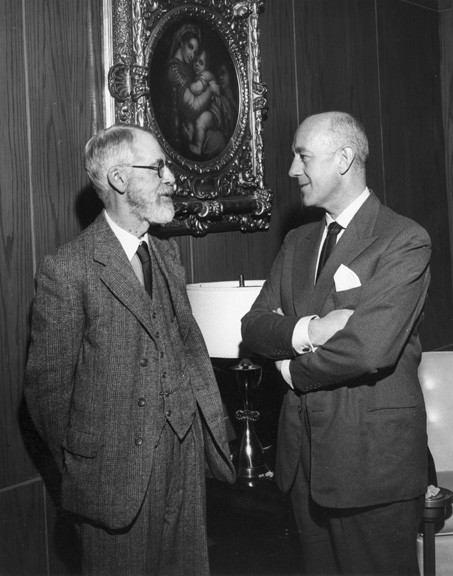
The Relevance of Christopher Dawson

by Gerald Russello

Taken and copyright from First Things, April 2002.

Not so long ago, before the dot-com bubble-burst and the September 11 terrorist attack, it seemed as if history would deliver all good things. The Dow was continuing its steady rise, and the nation seemingly faced no insurmountable problems. We were living at or near the end of history, with only a little tidying up to do at the rougher edges of the world before all would be permanently well. The events of last September compelled us to reconsider such rosy assumptions.

This pre-September 11 idyll was no anomaly. The belief in a perfect future has been a consistent feature of Western thought, emerging out of Christian hope of salvation in the next world. For the last two hundred years, however, this hope has been expressed usually in political or economic, rather than in religious, terms. This change has been so complete that the common presumption among elites, from the Davos World Economic Forum to the UN, is that this future path will entail the demise of religion. It is thus particularly appropriate that the Catholic University of America Press has reissued Christopher Dawson’s Progress and Religion (originally published in 1929) as part of a planned series of Dawson volumes. Long before Francis Fukuyama’s declaration of the end of history or Samuel Huntington’s clash of civilizations, Dawson (1889-1970) proposed a very different foundation for the study of human society. With Progress and Religion as well as such other books as The Age of the Gods (1928) and The Making of Europe (1932), Dawson unapologetically placed religion at the center of culture rather than on the periphery.

Dawson is one of those historians everyone should read but few actually do. It was not always so. In his lifetime, Arnold Toynbee and T. S. Eliot, among others, recognized his mastery of comparative history and religion and admired his crisp prose style. Almost alone in the 1920s and ’30s, he contended with those who denied religion any cultural significance. A young convert to Catholicism, Dawson was active for many years in ecumenical efforts in England. This experience had a clear impact on his awareness of cultural differences that is reflected in his sympathetic understanding of other cultures.

Progress and Religion is a direct attack on the nineteenth- and early twentieth-century social sciences and their understanding of progress. Now known as the “secularization thesis,” the theory of progress proposes that civilizational development is directly proportional to a decline in religious belief and influence. In three chapters, one each devoted to sociology, anthropology, and history, Dawson examines the thought of such figures as Condorcet, Comte, Frazer, and LePlay. Drawing on their work, the social sciences excluded religion, either through Cartesian rationalism, Spenglerian theories of civilizational life cycles, or supposed general laws of anthropological development. They uniformly neglected “the study of religion in its fundamental social aspects.” In the view of such thinkers, religion was “essentially a negative force like ignorance or tyranny” and so could not be a creative cultural influence.

Dawson overturned this entire way of thinking about culture. In passionate, disciplined prose, he demonstrated that materialist or environmental explanations of religious belief simply did not accord with the evidence. “Modern writers on anthropology and primitive thought have tended to assume that religion is a secondary phenomenon and that man’s earliest attitude to reality was a kind of empirical materialism.” On the contrary, as he wrote in 1925, the “great civilizations of the world do not produce the great religions as a kind of cultural by-product; in a very real sense the great religions are the foundations on which the great civilizations rest.” In her introduction to the new edition of the book, the distinguished anthropologist Mary Douglas notes that Dawson “artfully stages a dialogue between the eighteenth-century philosophers, Condorcet, Rousseau, Kant, and Hegel, and the people they thought of as primitive.” Religious faith takes on a different perspective if examined from the point of view of these people themselves, and not through the prism of anthropological theory. “The thin rationalism [of modern anthropology], which proceeded by arbitrarily separating one level of experience from the next, grossly distorted the subject matter and made a mockery of its pretensions to objectivity.” These thinkers largely ignored the brute fact that “an obscure and confused intuition of transcendent being” was present in and nfluenced both so-called primitive cultures and more advanced ones.

Progress and Religion shows, moreover, that “the religious factor has had a far more important share in the development of human cultures than that which has usually been ascribed to it.” Contrary to the assumptions of the progressive anthropologists, material and cultural progress need not go together. The early Christians in the Roman Empire, for example, created a more dynamic and vibrant culture than the dying, “higher” culture of the pagans. Likewise, Dawson notes peoples such as the Eskimo or Bushmen, whom the theorists of progress considered completely dominated by their physical surroundings. In fact, these cultures are the results “of a free and intelligent activity, and it expresses itself in an art and a folklore far richer and more original than that of many more advanced peoples.” Dawson was no cultural relativist, but his analysis reveals that the secular scale of values simply does not capture the reality of human social life. The lesson he drew was that religious faith is the spark of culture, and external material success will not survive its being extinguished. That lesson is particularly important today, when some continue to describe complex world cultures in simple, undifferentiated terms and understand them using the same imprecise Enlightenment concepts.

Recent anthropological scholarship has confirmed Dawson’s thesis about the religious basis of culture and cast serious doubt on the modern equation of progress with secularism. As such scholars as Rebecca French and David Hollinger have noted, religious ways of seeing the world remain the dominant interpretive tool for most people. Dawson anticipated this transition, insisting that progress “has begun to lose its hold on the mind of society ... because the phase of civilization of which it was characteristic is already beginning to pass away.” While a more positive assessment of religion’s role has gained some ground, most of the academy and the wider circle of intellectuals and writers continue to ignore the formative role of religion, in the West and throughout the world.

Religion is a natural human impulse, and if it cannot be expressed in culture, it will find an outlet in ideology. In Dawson’s time, the great temptations were the ideologies of fascism, communism, and Nazism. Today, our vulnerability is different. Elites in the West have become almost unable to understand religious motivations for conduct, even if the antiquated theory of progress no longer commands the scientific support it once did. This blindness has clear dangers not only with respect to our current efforts to understand Islam, but also in relation to other parts of the world, such as Tibet, and even in the United States itself, where the “culture wars” are largely motivated by a latent progressivism. The recent flare-up about evangelicals being “uneducated and easy to lead,” not to mention the efforts to explain away certain strains of Islam as motivated by economic or other nonreligious factors, are recurring echoes of the problem Dawson originally diagnosed. Despite its claim to universality, the secularization thesis, no less than the “end of history” schema, contributes little to our understanding of the place of religion in the world today.

America, which Dawson did not visit until the late 1950s when he was appointed to the first Stillman Chair in Roman Catholic Studies at Harvard, initially seemed to be his worst-case scenario. The nation regarded itself as the culmination of the project of human freedom, where old loyalties were cast aside in favor of the novus ordo seclorum, and where self-invention was part of the national character. In the 1920s and ’30s, Dawson thought that America could not resist becoming “a purely secular type of culture which subordinates the whole of life to practical and economic ends and leaves no room for independent spiritual activity.” In Progress and Religion, American civilization was the embodiment of technology gone awry: life acquired meaning only through consumption and production, by “more cinemas, motor-cars for all, wireless installations, more elaborate methods of killing people, purchase on the hire system, preserved foods, and picture papers.” (One can only wonder what Dawson would have made of the Internet.)

However, in an important lecture on “America and the Secularization of Modern Culture,” presented in the same year that John Courtney Murray’s We Hold These Truths was published (1960), Dawson set forth a more hopeful view. America’s origins in the dissenting and pluralist tradition of Protestantism had established a realm of personal and communal freedom outside the power of the state. The nation’s individualism clearly bore the imprint of the Christian focus on the sacredness of the person, despite occasional lapses into narcissism. Just as importantly, American culture had developed without the anticlericalism or antireligious character that was common among its European counterparts. Further, America had a clear, if legally unrecognized, role for religion in public life. While Dawson foresaw that the sometimes stark separation of the world of business and politics from that of religious belief threatened to produce what has been called a naked public square, he nevertheless thought that because the nation combined a deep religiosity with enormous material wealth and productivity, there “is great opportunity in America that may never be repeated.”

Because of this heritage, Americans are able to understand religious belief. More importantly, at its best the nation can be a model of how to interpret modern political forms through the eyes of faith. The ability to hold strong religious convictions and to profess democratic principles is America’s great contribution to the world, despite elite opinion about the “separation of church and state” on the one hand or a restricted “Christian America” on the other. This comfort with the modern mix of religion and politics may be of even greater importance in the coming century.